Experimental Data Assets for AI4S: Repeatability, Standardization and Transferability
Before discussing experimental data, we will first clarify Ou Shisheng's fundamental definition of data requirements for AI4S. The data required by AI4S is not simply a large volume of data or a superficial unification of recording formats. While high-throughput systems increase the efficiency of data generation over time, and standardization regulates the criteria for recording data, neither addresses a more fundamental question: Do data from different instruments and laboratories truly represent the same physicochemical process, allowing for mutual comparison? If the nominal reaction conditions are the same, but the actual reaction states within the system are different, then even a massive data set only increases the sample count. This is insufficient for building scientific models that can be reliably applied elsewhere.
The true value of experimental data lies in the reliability of its condition-response relationship. This means the actual reaction state must be precisely characterized, any variations introduced by equipment or scale must be explicitly controlled, results from different platforms must be independently validated externally, and the data should still allow the same model to make accurate predictions even when disconnected from the original instrument. The AI4S closed loop operates by leveraging the knowledge-generation capacity of the experimental system. When data from multiple sources can be mapped into a single, unified experimental coordinate system, the cycle of "hypothesis–validation–iteration" will produce reusable scientific knowledge, not just isolated data points. A 2026 intercomparison study involving multiple laboratories, published in Nature Catalysis, directly supports this perspective.
The correlation holds within a single laboratory but becomes insignificant after data aggregation.
Four laboratories collaborated on this study, investigating Rh/TiO₂ catalysts for CO₂ hydrogenation. To ensure consistency, all participants used the same catalyst batch and followed an identical testing protocol. The research examined how various inputs, such as reaction temperature, Rh loading, and synthesis methods, influenced outputs like conversion, selectivity, and the formation rates of CO and CH₄. Instead of just comparing individual measurements, the study precisely measured both the variability within each laboratory and the differences between laboratories.
The main conclusion was not simply that results varied between labs, but that specific, clear relationships between inputs and outputs observed within one lab became statistically insignificant when inter-laboratory variability was considered.
This highlights two distinct types of problems. When the limitation is high random error, conducting more replicate experiments can improve the estimation of parameters. However, when systematic differences exist between experimental setups, pooling data directly incorrectly embeds instrument or experimental biases into the fundamental chemical relationships. In such cases, larger datasets do not necessarily lead to more dependable models; rather, they can mask the underlying sources of error.
 Figure 1|Identical catalysts and protocols can lead to different real reaction states. Data transferability requires three-stage validation: protocol, physical and cross-platform.
Repeatability, Standardization, and Transferability: Distinct Concepts
When discussing data assets, these three terms are often used interchangeably. To avoid confusion, this paper defines them operationally as follows:
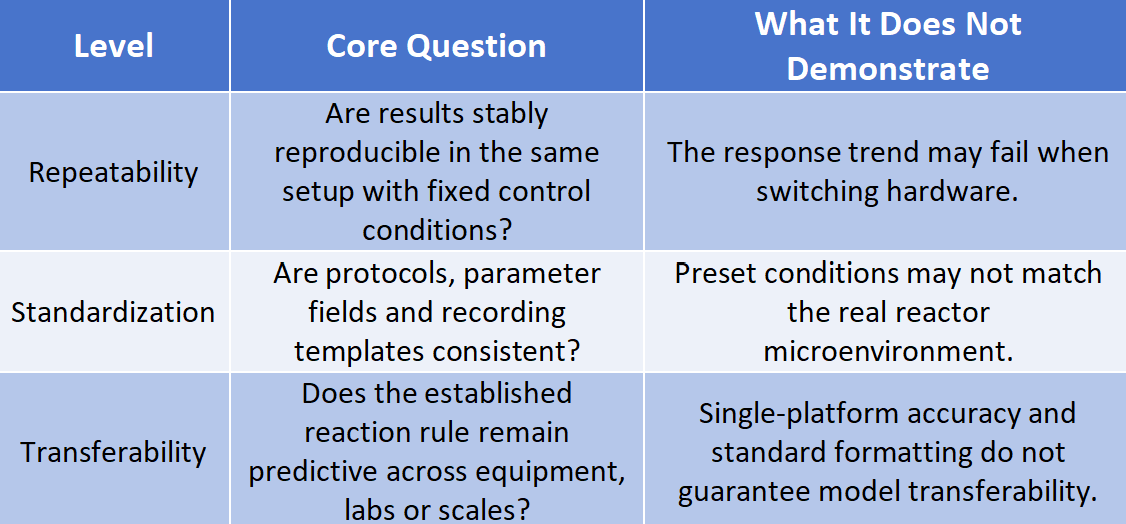
Repeatability and standardization are necessary but not sufficient for achieving transferability. Internal data consistency alone cannot validate transferability; it must be confirmed through tests conducted outside the original experimental system. This is the key difference between transferability and simply enhancing data recording methods.
Why Do Models Learn "Equipment Fingerprints"?
The experimentally measured response is influenced by more than just intrinsic chemistry. Factors such as mixing, heat transfer, mass transfer, hardware design, scale, and operating procedures also play a significant role. The observed relationship can be generally expressed as:
Observed Response = f (Intrinsic Chemistry, Actual Transport State, Equipment & Scale, Operational Procedures)
The term "equipment fingerprint" does not refer to a device's brand or serial number. Instead, it signifies systematic biases introduced into measurements by the hardware and its operational method. For example, two systems might both record "80 °C," but the actual material temperature, local temperature gradients, and thermal history could differ. Similarly, both might indicate a "2-hour reaction," yet the time needed for mixing to stabilize and the effective reaction path may not be the same.
If training data sets only include nominal conditions and final responses, the model cannot differentiate between intrinsic chemistry and contributions from the equipment. Within a single instrument, these biases might be incorporated into a stable apparent relationship, potentially leading to high fitting accuracy. However, this learned mapping may fail when the equipment is changed. High precision on one platform merely demonstrates interpolation performance on that platform, not the capability for generalization across different platforms.
Three-Tier Acceptance for Transferability: Protocol, Physics, Verification
Tier 1: Protocol Portability — Can an experiment be accurately executed on a different system?
A 2026 framework for orchestrated labs, published in Device, highlights that many self-driving laboratory workflows are closely tied to specific software and hardware. This makes it difficult to replicate experiments across different platforms. The proposed solution involves creating shared intermediate representations, allowing experimental workflows to be validated, ported, and redeployed. This tier focuses on "how to perform the experiment" but doesn't guarantee that results from different systems have the same physical meaning.
Tier 2: Physical Comparability — Do nominal conditions correspond to identical actual reaction states?
Beyond basic settings like formulation, temperature, pressure, and duration, it's crucial to standardize measured mixing conditions, residence time distribution, heat and mass transfer status, reactor geometry, and key process variables specific to the reaction system. Reporting measurement uncertainty is also vital. Without controlling these factors, identical written protocols won't lead to identical reaction environments.
Tier 3: Cross-Platform Verifiability — Does the established relationship still hold outside the original system?
Verification methods include cyclic intercomparison with reference samples, external cross-platform validation, or testing models by separating training and test sets by platform. The main goal isn't the model's performance on existing data, but its predictive ability on new, varied data from other platforms.
None of these three tiers can be skipped. With only protocol portability, data may be generated consistently but lack equivalent physical meaning. With only physical parameters, reproducibility remains difficult without standardized workflows. Without cross-platform verification, it's impossible to determine if the first two tiers are sufficient.
The True Value of Ou Shisheng's Continuous Flow Approach: Transforming Experimental Conditions into Describable Physical Quantities
Within this framework, Ou shisheng's adoption of continuous flow offers advantages far beyond simply accelerating experimental throughput. Its greater benefit lies in the ability to convert reaction conditions into well-defined, measurable physical quantities. For instance, reaction progress can be characterized by flow rates and residence time distribution. The reaction environment is defined by channel geometry, actual temperature and pressure, and heat and mass transfer parameters. In-situ process data helps distinguish intrinsic kinetics from transport limitations. Compared to experiments described only by "reactor temperature, stirring speed, and reaction duration," these quantities align better with the experimental coordinate system needed for modeling.
However, it's crucial to emphasize that continuous flow alone does not guarantee transferability. Channel dimensions, construction materials, sensors, mixing configurations, and control strategies can also introduce new equipment fingerprints. Without measured physical parameters, standardized protocols, and cross-platform validation, data generated in microreactors may only be valid for the original hardware.
Therefore, Ou Shisheng utilizes microreactor technology to assemble batching, reaction, separation, detection, and software components into standardized modules. The goal is not merely to generate more data points, but to establish a transferable experimental coordinate system. This allows experimental workflows to be executed precisely, actual reaction states to be fully measured, and derived relationships to be verified across different platforms. Building on this foundation, high-throughput experimentation is more likely to evolve into a cumulative capability for generating scientific knowledge.
Reference:
Bac, S. et al. Quantifying uncertainty in catalyst activity and deactivation during CO₂ hydrogenation via round-robin testing for datadriven modelling. Nature Catalysis, 2026, 9: 912–923. DOI: 10.1038/s41929-026-01559-y.
Gottstein, W. et al. A foundational representation for an orchestrated lab. Device, 2026,4,101202. DOI: 10.1016/j.device.2026.101202.
Canty, R. B. & Abolhasani, M. The past, present and future of self-driving laboratories. Nature Reviews Chemistry, 2026, 10: 523–537. DOI: 10.1038/s41570-026-00847-2.
The road to selfdriving laboratories in industry. Nature Synthesis, 2026. DOI: 10.1038/s44160-026-01194-2.